KRAEMER GALLERY WORKS OF ART
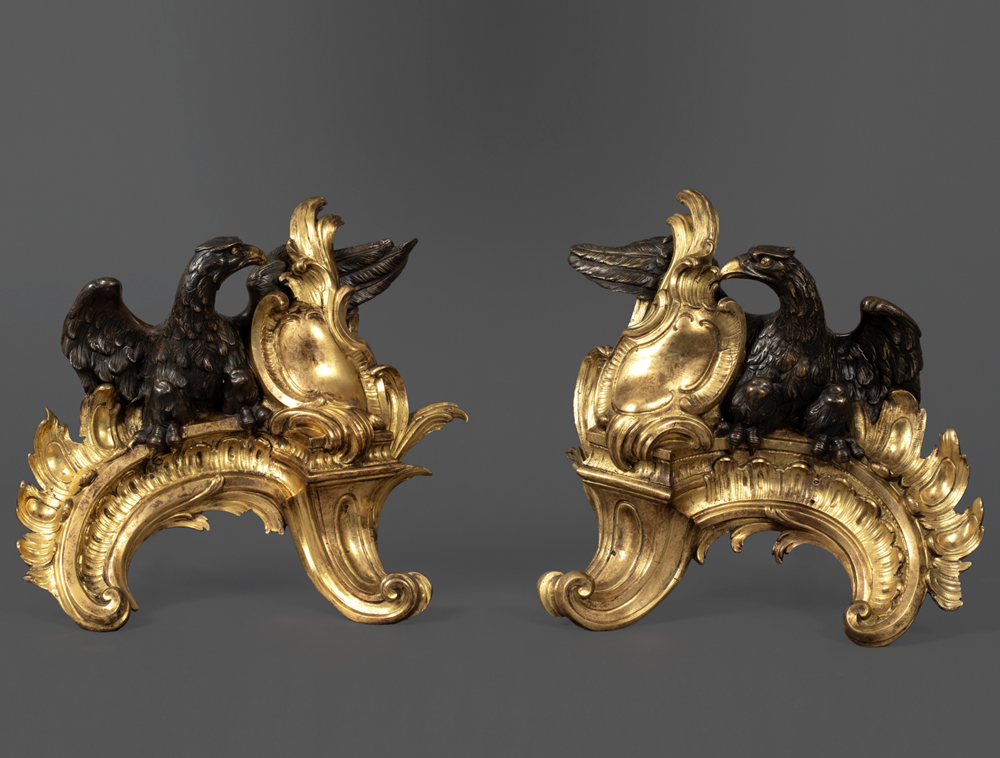
An exceptional pair of mid-eighteenth-century
Rocaille chased, patinated and gilded bronze
fire dogs, each topped by an eagle
37 cm. High = 14 ½ inches
40 cm. Wide = 15 ½ inches
23,5 cm. Deep = 9 ¼ inches (approximately)
Usual restorations and maintenance.
These objects are characteristic of works that can also be displayed as art pieces on furniture.
Approaching objects, including similarities with the fire dogs.
Bibliography:
For the representation of eagles and eagle heads associated with the Duchy of Lorraine:
– BELLAIGUE Geoffrey de, The James A. de Rothschild Collection at Waddesdon Manor, Volume II, The National
Trust-Office du Livre, Fribourg & London, 1974, pp. 823-825, n°229-230.
At Waddesdon Manor, there are two pairs of large wall lights created by the bronzier Dewez for the palace of
Duke Charles of Lorraine in Brussels.
He was Governor of the Austrian Netherlands and the uncle of Marie- Antoinette. At the center, stand eagles with unfolded wings, their beaks, eyes, and claws gilded. Each eagle wears a necklace featuring the Lorraine cross.
– CHARLES-GAFFIOT Jacques, Lunéville, faste du Versailles lorrain, Éditions Didier Carpentier, Paris, 2003, t. I : pp.27, 28-29, 201 and 257 ; t. II : pp. 84, 101 and 129.
For elements of architectural design, architecture, and woodwork:
– CHARLES-GAFFIOT Jacques, Le mobilier d’apparat des Palais lorrains, Éditions Serpenoise, Metz, 2009, pp. 24, 29, 67-68 and 97.
– COFFIN Sarah (dir.), Rococo : the continuing curve, 1730-2008, exhibition catalogue, [New York, Cooper-Hewitt
national museum of design, 7 March-16 July 2008], Cooper-Hewitt, National Design Museum, Smithsonian Institution, New York, 2008.
– KIMBALL Fiske, Le style Louis XV, origine et évolution du rococo, Éditions Picard, Paris, 1949, fig. 170, 228, 229 and 255.
Each displays a patinated eagle with unfolded wings, looking towards its matching counterpart. Their beaks, eyes, and claws are gilded.
They are placed near a large, asymmetrical rocaille cartouche, surrounded by volutes, curved and stylized reeds, and scrolls.
On the opposite side, there are “jagged rooster combs” adorned with foliage and fluting, set on a rounded base that slopes downward.
This base is chased with small flutes and leaves that follow the shape, along with a scroll.
The asymmetrical forepart features a voluted, scrolled, and curved foot, with an oval central flute, the entire section being topped with a moulding.