
KRAEMER GALLERY WORKS OF ART
Louis XV chased, pierced and gilded bronze
three-dial clock
Movement signed “Ageron à Paris”
52 cm. High = 20 ½ inches
39,5 cm. Wide = 15 ½ inches
17,5 cm. Deep = 7 inches
Usual restorations and maintenance
François AGERON was received as a Master Clockmaker on 14 July 1741. He was a highly regarded clockmaker whose workshop was particularly renowned for its complicated movements. He used gilt-bronze cases made by celebrated bronziers such as the Caffiéris, J.-J. de Saint-Germain and the Osmonds.
His clientele included the Marquise de Montesquiou, Mademoiselle Laguerre, the Dukes of Rohan and Zweibrücken, the Marquis de Dupleix (Governor of the French Indies), and Monsieur Bonnemet, a great collector of furniture and clocks during the reign of Louis XV, some of whose possessions are now in the Rothschild Collection at Waddesdon Manor.
His works figure in the following Museums :
– Museum of Fine Arts, Boston.
– Musées Royaux d’ Art et d’Histoire, Brussels.
– Rezidenz Museum, Munich.
– Musée du Louvre, Paris.
– Musée des Arts Décoratifs, Paris.
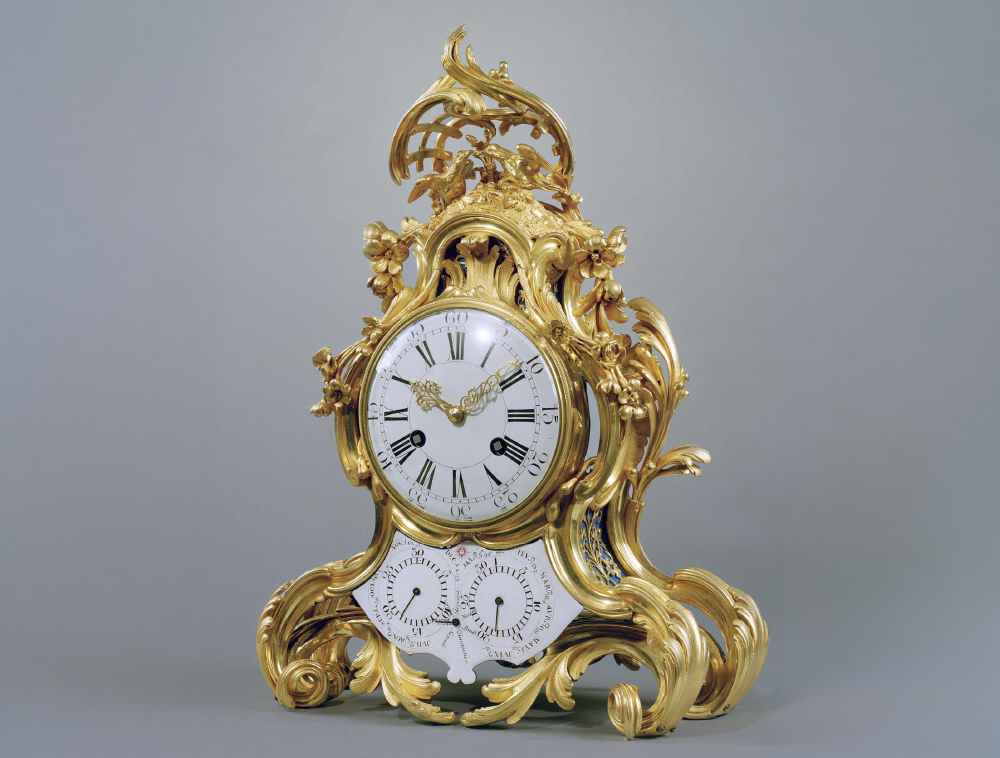
It is raised on four scrolling curly feet with curves and counter curves, adorned with foliations.
The fore-legs split in two strong confronted volutes at the middle and frame the complementary dials as a cartouche,
Two volutes also untie at the back.
The base also supports a rocaille terrace above which are the mechanisms and the movement.
At mid-height, around the dial’s window, there are moulded ribbed and scrolled volutes adorned with falls of flourished branches on the front, and foliations and berries at the back. On the sides, there are motifs of stylized leaves and rocailles, (also running at the back). On each side too, there is also an open-work and engraved “lacework”, with an elaborate décor of branches and foliations.
Large flattened rocaille leaves complete the front and link the arched fronton which itself supports another smaller rocaille terrace, from which emerge on each side a strong flourished and foliated branch. On this ground, are acorns and flowers, two confronting birds with spread out wings on both sides of a small acorned shrub.
They are sheltered with a treillis-lattice which forwards the back pillars and terminate as foliated volutes. The clock with days of the month of 30 and 31 divisions.
The small dials of the days of the week and fixed indication of each month of the equation of time (differential between the average-medium time and the sun at the zenith of the place).